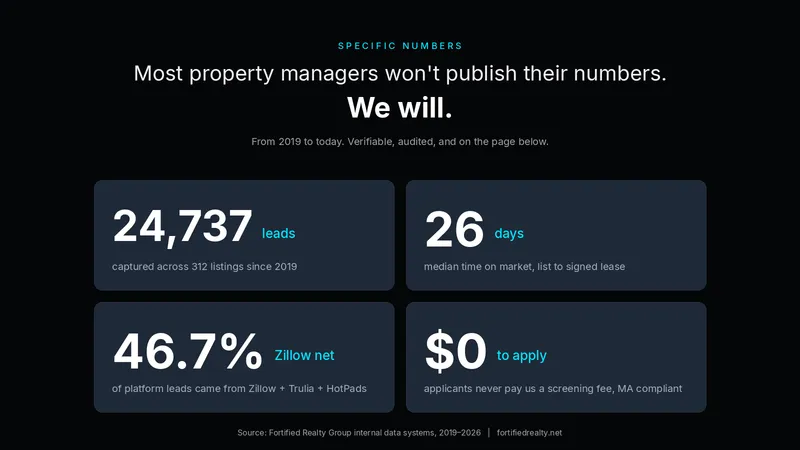
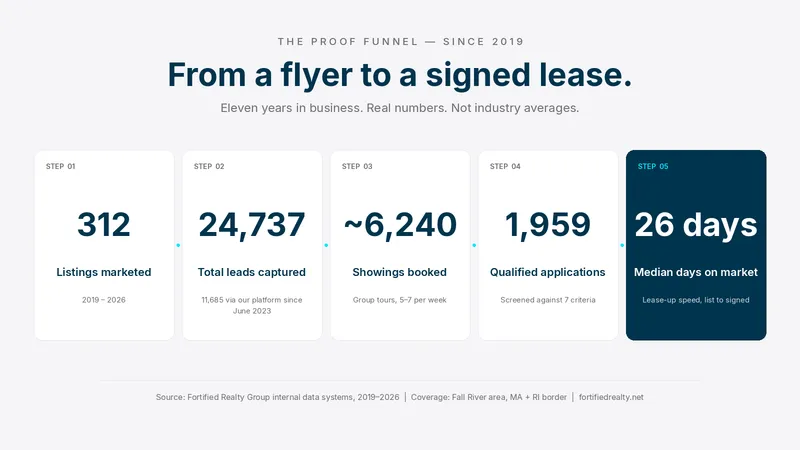
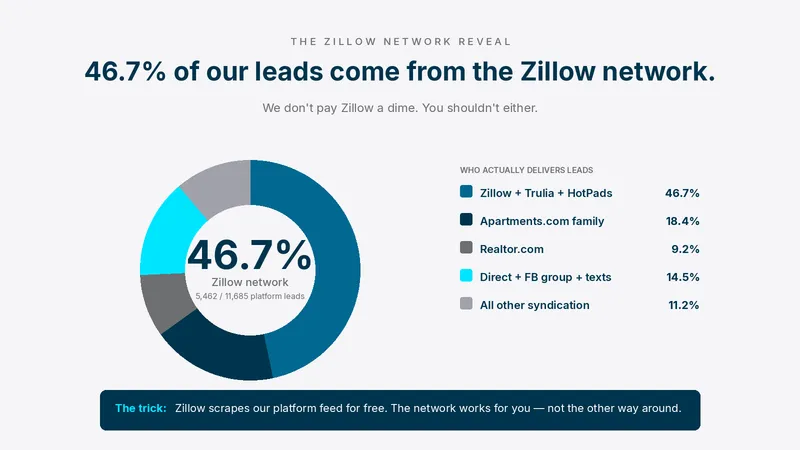
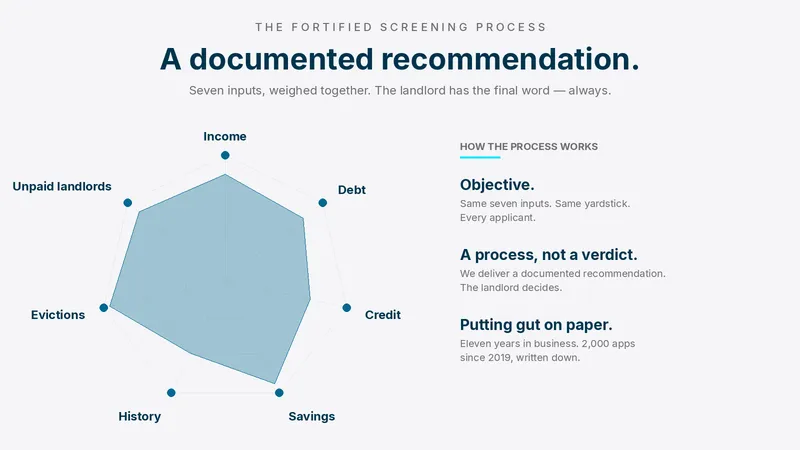
This is the first time we've ever publicly walked through how our screening actually works. Eleven years in business since 2015, 24,000+ people across our funnels, 2,000 completed applications since 2019 alone — the Fortified screening process is our way of putting that pattern recognition on paper, so a gut feeling becomes a conversation instead of a closed door.
Objective
Same seven inputs for everyone
Income-to-rent, debt-to-income, credit, available funds, rental history, eviction record, unpaid landlords. These are the inputs we weigh — together, with mitigating factors, every time.
Level playing field
Same yardstick, every applicant
A Section 8 voucher holder, a self-employed barber, a corporate W-2, and an out-of-state transplant all walk through the same seven gates. Source-of-income, familial status, and protected-class language never enter the math.
A tool, not a verdict
Landlord has the final word
We bring you a documented recommendation. The decision is always yours — you can approve a borderline file or decline a strong-on-paper one. Either way, the reasoning is written down and defensible.
Why this process exists. After eleven years in this business — over 24,000 people through our funnels, 2,000 completed applications since 2019 alone — we've developed a gut for who's going to thrive in a unit and who's going to struggle. The Fortified screening process is the discipline of putting that gut on paper. It forces us to articulate why, so we're not making a vibes-based decision in a fair-housing-regulated business. The process is internal — applicants don't see a verdict on their forehead. What they see is a clear, documented decision, and if there's weakness on the file, we open a real conversation about it.
How a single bad input gets weighed. One rough number doesn't sink an applicant. We look at the whole picture: an applicant with bad credit but a strong rental history, real money in the bank, and a steady income story usually clears the bar. An applicant with bad credit plus nine prior evictions plus $10,000 owed to previous landlords is a different conversation entirely — the negatives are piling on, and our process reflects that pile-on. We do not deny on credit alone. We deny on a pattern.
When the file is weak, we have the conversation. If our process surfaces that an applicant is on the edge — income is a little light, credit is rough, the rental history has a gap — that's not a closed door, that's the start of a conversation. We'll say it out loud: "Your income's borderline for this rent — would a cosigner work?" Or: "If you can show another two months of savings in the account, we can take another look." The process lets us set both the tenant and the landlord up for success instead of pretending the weakness isn't there. That's what putting gut on paper actually buys you.
Same-day decisions on complete files. Once an application is complete, you get our written recommendation the same business day — with the reasoning, the mitigating factors, and the documented trail. No black-box delay, no "we'll get back to you next week."
The final decision always rests with you, the landlord. No matter how strong the file, no matter how weak — you are the owner of record. We bring you a defensible recommendation backed by a documented decision trail. You sign the lease, or you don't. That doesn't change.
What we don't ask, and why. We don't ask criminal history on the application. Massachusetts law and the 2016 HUD disparate-impact guidance both make blanket criminal-history denials a fair-housing risk — and Massachusetts goes further: arrest records can't be used at all, and CORI access is regulated. We check the public Massachusetts Trial Court eviction record (and exclude sealed cases under G.L. c. 239 §16), but we don't run a felony question on the form. Source-of-income discrimination is illegal in Massachusetts under G.L. c. 151B §4 — Section 8 vouchers are welcome and processed the same way as any other applicant.